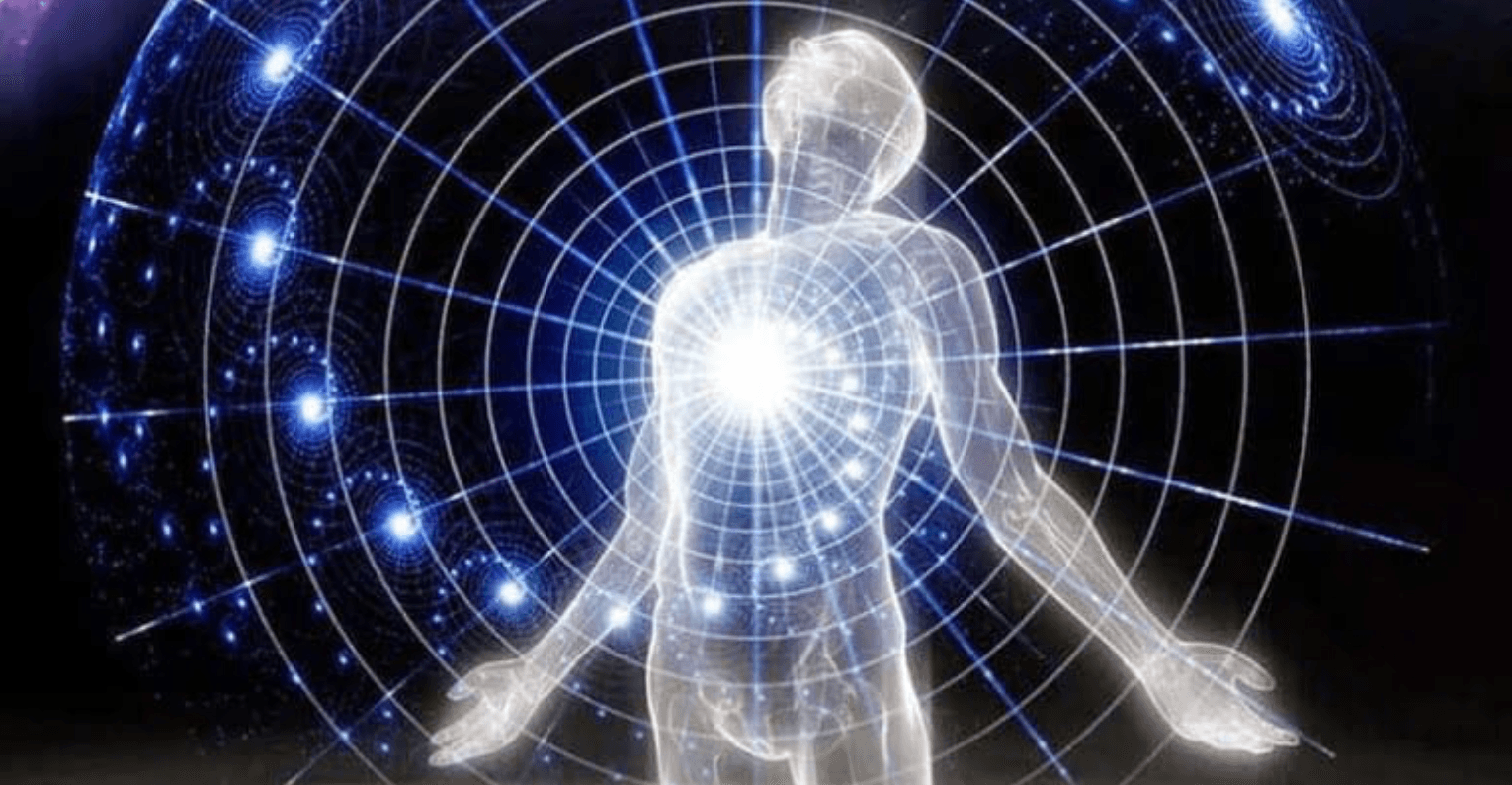
If you've ever scrolled through a yoga, meditation, or healing account on TikTok, you've likely come across phrases like "raise your frequency to 5D," "living in high frequency," or "stepping out of 3D." This isn't a scientific concept — it's language borrowed from the New Age movement, now used widely across the global wellness community to describe inner experience. Understanding its origin and its limits will help you use the concept with intention, rather than repeating it vaguely.
I. What does 5D actually mean?
5D stands for "Fifth Dimension." In physics, "dimension" is a strict mathematical concept. But in spiritual language, 5D is used in an entirely different sense: it describes a state of consciousness, not a physical location.
The underlying idea: everything in the universe — including human emotion and consciousness — is said to carry its own vibrational frequency. As that frequency shifts, so does the way a person perceives and responds to the world. 5D, in this framing, is described as a different "frequency band" from everyday life — one in which a person operates from connection and calm rather than reaction and fear.
II. 3D vs. 5D: two ways of experiencing life
Most writing on this topic centers on comparing two states — not to pass judgment, but to clarify the difference in how a person responds to the same circumstance.
3D CONSCIOUSNESS
- Reacts through logic and the senses, led by the ego
- Measures self-worth through material things, status, achievement
- Views the world through duality: right/wrong, winning/losing
- Dominant emotions: anxiety, comparison, defensiveness
5D CONSCIOUSNESS
- Responds through intuition and presence, led by the heart
- Experiences connection rather than separation or competition
- Accepts rather than judges — treats every experience as a lesson
- Dominant emotions: calm, gratitude, trust
Important note: Most writers on this topic stress that 5D isn't a fixed destination you "reach" and stay in forever. It's a state people move in and out of — you might touch it during a single moment of deep peace, then slip back into familiar reactive patterns under pressure. The difference lies in how often, and how quickly, you return to that state.
III. The "5D soul" and the awakening journey
In spiritual language, the shift from 3D to 5D is often called ascension. This isn't a religious concept about dying or going to heaven — it describes an internal process: expanding awareness, releasing old fears and patterns, and living closer to one's connected nature.
People described as living in a 5D state are typically characterized by: clarity of life purpose, a heightened sensitivity beyond ordinary perception, gratitude and presence in the moment, and a felt sense of connection to nature and others rather than separation.
IV. Why the concept resonates so strongly in wellness
- It doesn't require a specific religious framework. "5D" is neutral language, accessible to audiences across faiths and cultures — unlike concepts tied to a specific religious tradition.
- It names a feeling people struggle to describe. Many people experience calm, connection, or "lightness" after yoga or meditation but find it hard to put into words — "high frequency" gives them a concrete vocabulary.
- It fits naturally with yoga, meditation, and healing. This is exactly what the wellness industry is already building and selling.
- It has strong linguistic pull on social media. Phrases like "raise your frequency," "high vibration," "stepping out of 3D" have a catchy rhythm that spreads easily on TikTok and Instagram.
What to keep in mind when using this concept
This is a spiritual belief, not a measurable scientific fact — there's no physical basis showing that human consciousness "vibrates" at a specific Hz frequency. So when bringing 5D language into brand content, three things are worth considering:
- Use it as an emotional metaphor (calm, connection, presence) rather than a scientific claim like "frequency X Hz heals condition Y."
- Avoid association with the more extreme corners of the global 5D community, which often blend with conspiracy thinking — especially if your brand targets a highly educated or mainstream media audience.
- Keep the tone measured and grounded. The concept is easily labeled "pseudoscience" if presented without nuance or taken as absolute fact.
The bottom line
5D isn't a physical place or a scientific phenomenon — it's a metaphor for a way of living: more connected, less driven by fear. Used well, it's powerful language for talking about inner transformation in wellness spaces. Used carelessly, it quickly turns hollow or backfires with a skeptical audience. The line comes down to whether you stay honest about its nature as metaphor.